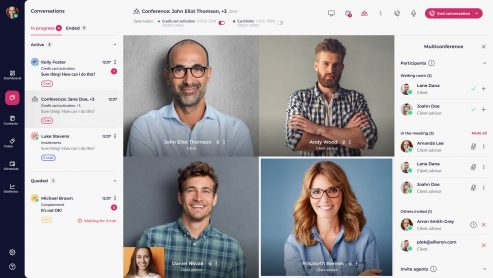



Customer engagement in banking is becoming increasingly demanding. Today, branch advisors handle not only simple inquiries but also complex processes related to loans, investments, business products, and premium customer service. In these scenarios, success depends not only on product expertise but also on the ability to engage customers quickly, maintain full case context, and manage an assigned customer portfolio effectively.
LiveBank addresses these needs by developing tools that help advisors deliver more proactive, digital, and structured customer service. One such solution is the Contacts Module, which enables advisors to work with their assigned customer portfolio and initiate communication without waiting for the customer to start the conversation.
Table of Contents
The Contacts Module as the Advisor’s Work Hub
The Contacts module in LiveBank allows advisors to view the list of customers they are authorized to communicate with based on their permissions and business relationships. Advisors can create this list using previous interactions, CRM data, or relationship matrices, giving them visibility into customers assigned to them in line with the organization’s operating model. Following video meetings, summaries and key decisions can also be automatically transferred to the CRM, enabling advisors to track whether the customer attended, how long the meeting lasted, and what was agreed.
In day-to-day work, this means advisors are no longer limited to handling incoming conversations. They can actively manage customer relationships, search for a customer by first name, last name, customer number, or company identifier, and then start or continue a conversation in the context of a specific case. Importantly, advisors can also analyze conversations to fully understand whether a given session had the expected impact on the process.
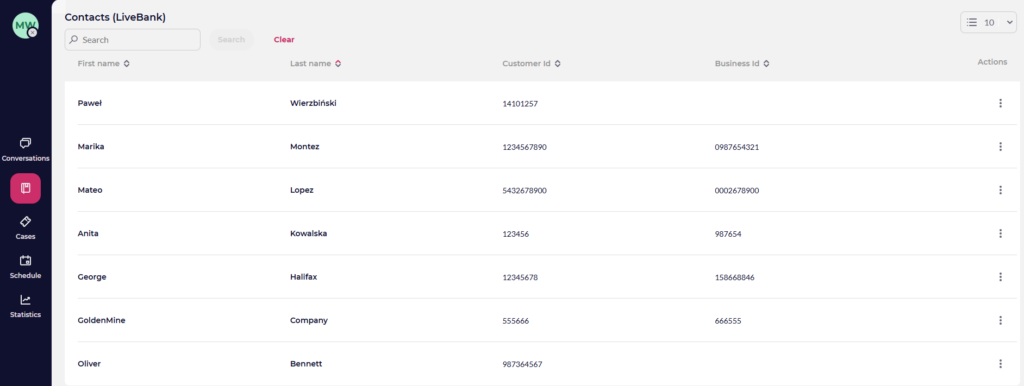
Screenshot of the new Contacts module in the LiveBank platform
Example 1: A Business Advisor Managing a Credit Process
For business customers, preparing a credit offer rarely ends within a single conversation. The advisor needs to collect documents, clarify investment needs, discuss collateral, share a list of missing information, and often return to the customer at subsequent stages of the analysis. With LiveBank, the advisor can work from a list of assigned companies, select the right customer, and send an outbound message directly through a secure digital channel. After the meeting, the advisor can immediately transfer the summary and key conclusions to the CRM, enabling reporting on meeting attendance and duration.
Example 2: Secure Asynchronous Communication with the Customer
Not every customer can respond at the exact moment an advisor tries to reach them. In a traditional model, this often means repeated phone calls, emails, or postponing the case. In LiveBank, communication can be handled asynchronously: the advisor sends a message from the Contacts module, and the customer reads it when they return to the mobile app or online banking. The customer does not need to answer the phone during the advisor’s working hours, while still retaining access to the message, conversation history, and materials shared through a secure channel. This approach strengthens the relationship because the customer receives structured information that is available exactly when needed. For the bank, it means better process control and a lower risk of losing key arrangements.
Example 3: A Proactive Campaign Targeting a Customer Portfolio
The Contacts module can support not only individual cases, but also campaign-driven activities. An advisor or sales team can use an assigned customer list to inform customers about a new offer, changes to product terms, specialist availability, or the need to update data. For example, the bank can launch a campaign for SME customers focused on seasonal financing. Advisors receive a list of assigned companies, select customers with the highest potential, and initiate a conversation through LiveBank. During the conversation, they can share offer materials, propose a video meeting, collect documents, or route the customer to a specialist. In addition, advanced reporting enables the bank to monitor who actually participated in the campaign, what their preferences were, and which stage each case has reached.
Example 4: Combining Outbound Contact with a Video Meeting
In many processes, a text message alone is not enough. The customer may need an explanation of the offer, a presentation of calculations, a document review, or support in completing a form. The advisor can use LiveBank to invite the customer to a video meeting and continue service through chat, audio, or video channels. After the conversation, the advisor transfers the summary and key conclusions to the CRM. As a result, the advisor can see whether the customer actually attended, how long the meeting lasted, and what steps were taken. This helps the advisor plan follow-up actions more effectively and identify the key moments when the customer may require additional support. Advanced conversations, such as those related to mortgage loans, often last around 45 minutes, allowing advisors to manage their time more effectively and prepare for the most important stages of the discussion.
Business Benefits for the Bank and the Advisor
- Proactive customer portfolio management – the advisor can initiate contact instead of waiting for the customer to reach out.
- Stronger case context – communication is connected to a specific case and the history of previous interactions.
- Shorter service time – customers receive information, documents, and meeting invitations faster.
- Greater advisor availability – asynchronous chat enables the case to continue even when both parties aren’t available at the same time.
- Secure information exchange – communication takes place in a controlled environment, with the ability to preserve conversation history and documents.
- Support for selling complex products – LiveBank is well suited to processes that require explanation, analysis, and multiple touchpoints.
Final Thoughts on A More Proactive Approach to Customer Engagement with Contacts Module
LiveBank enables advisors to move from a reactive service model to proactive relationship management. The Contacts module, outbound communication, asynchronous service, video meetings, and CRM integration create an environment in which advisors can guide customers more effectively through processes that require time, trust, and multiple interactions. For the bank, this means greater team efficiency, higher service quality, and stronger sales potential. For the customer, it means easier contact, faster access to information, and the ability to complete complex matters without frequent branch visits.